
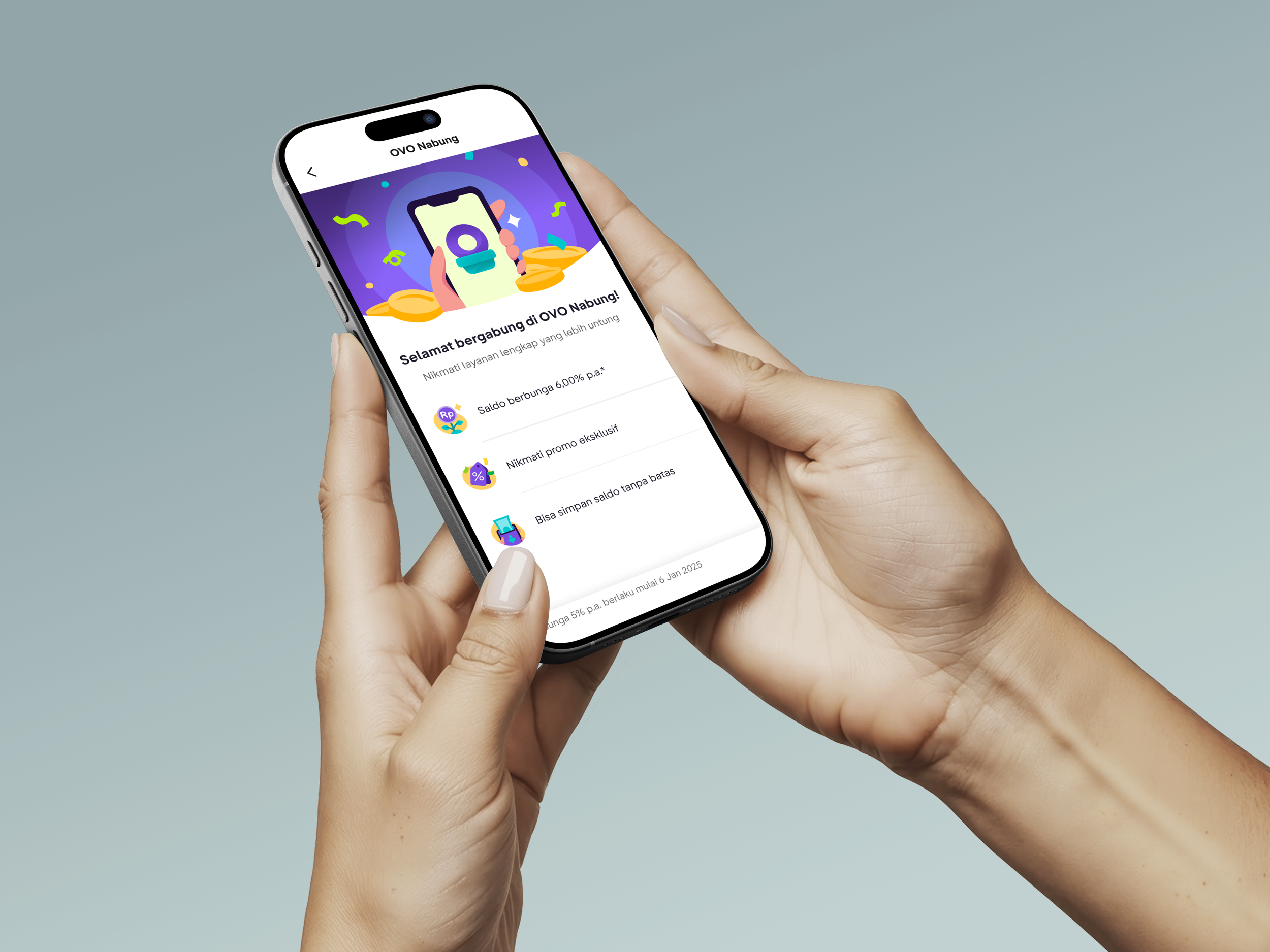
System Design /
Cross-Functional Alignment / Leadership & Influence
Superbank + OVO + Grab Integration
Grab’s digital bank (Superbank) aimed to acquire its first 1 million users by year-end. To get there, they needed a fast, compliant integration inside Grab’s e-wallet (OVO). Design and ship an MVP in ~3 months for regulator approval.
I led design alignment across Grab, OVO, and Superbank by driving the flows, the rules, and the decisions required to ship something compliant, feasible, and scalable under extreme time pressure.
My Role
Led design across OVO, Grab, and Superbank
Drove end-to-end design across OVO, Grab, and Superbank
Aligned PMs, compliance, engineering, design and many other teams
Made the scope, branding, and decisions needed to unblock teams
Balanced short-term MVP with principles for future phases
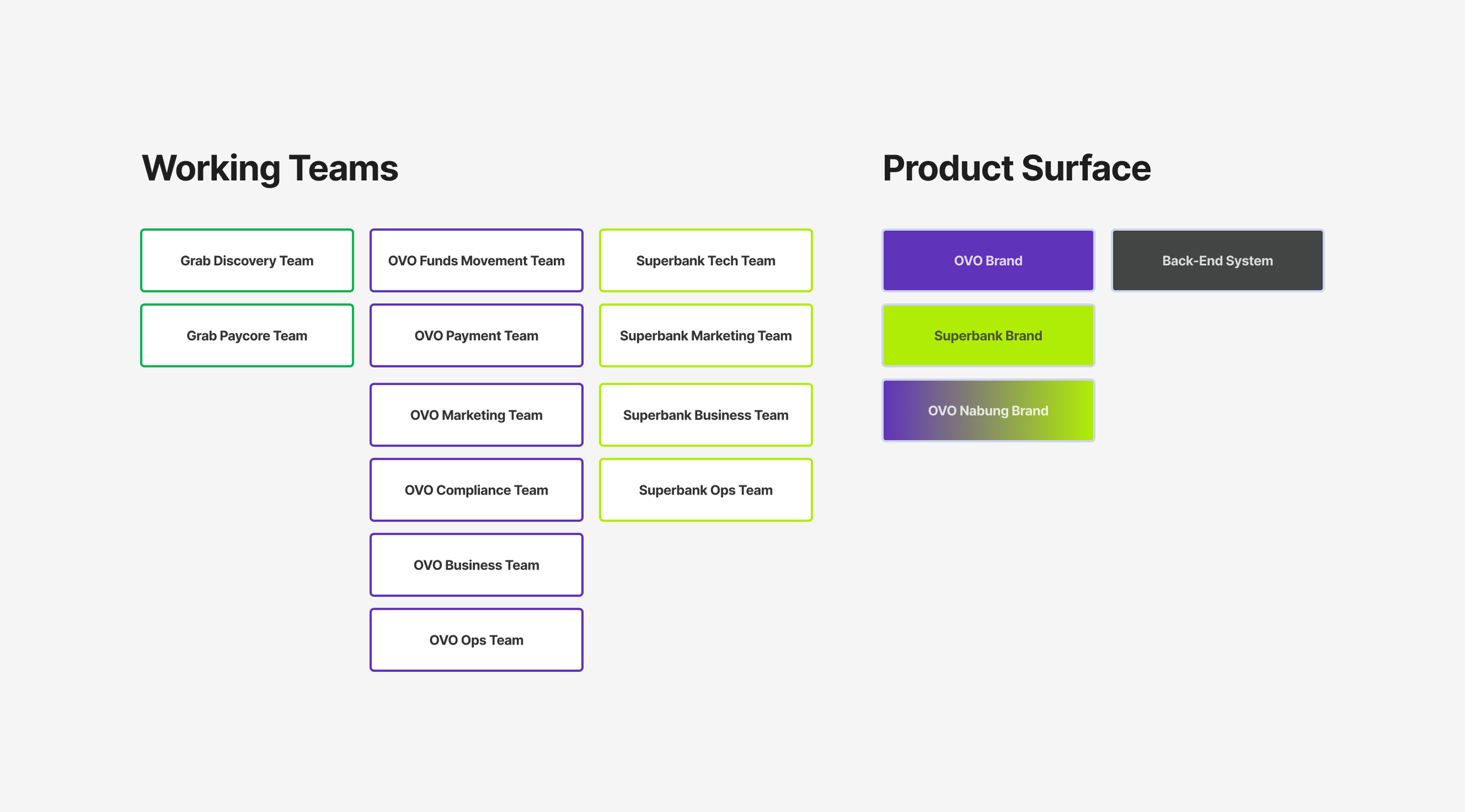
Working Teams and Product Surface
The Situation
When work started, nothing was defined
No name
No brand identity
No logo/icon
No finalized product scope
No clarity on cross-app upgrade rules
No alignment on what was mandatory for regulator approval
Different companies, different processes, different working styles
Despite that, we had to deliver design fast so engineering could develop, while keeping space for the late-arriving strategic decisions.
Challenges
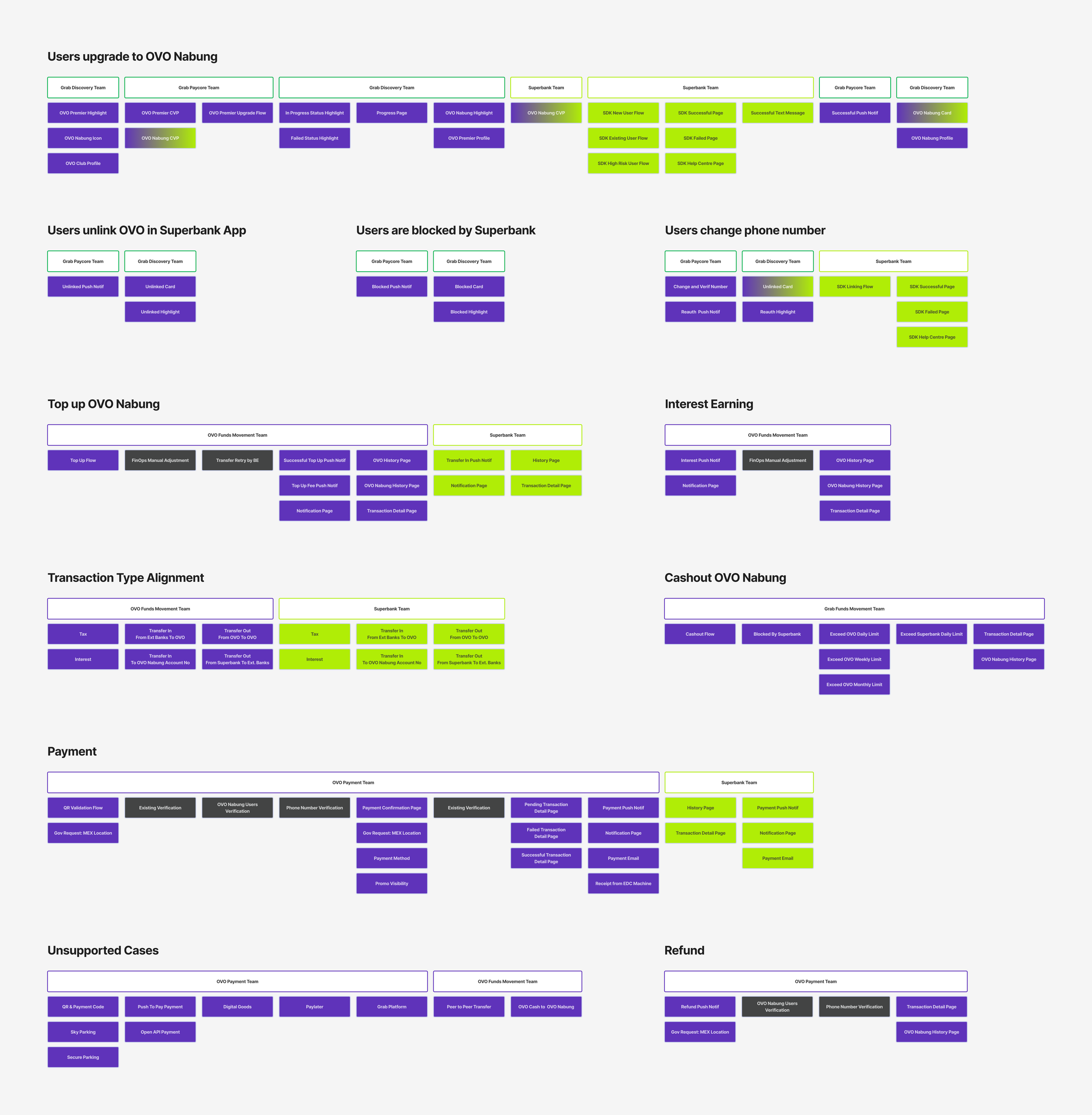
System snapshot for regulator approval with product surface and team indicator
Three companies, three priorities
OVO, Superbank, and Grab operated differently. Each had its own process and expectations.
Regulator-driven constraints
Banking requirements affected:
Wording
Verification steps
Required screens
Branding hierarchy
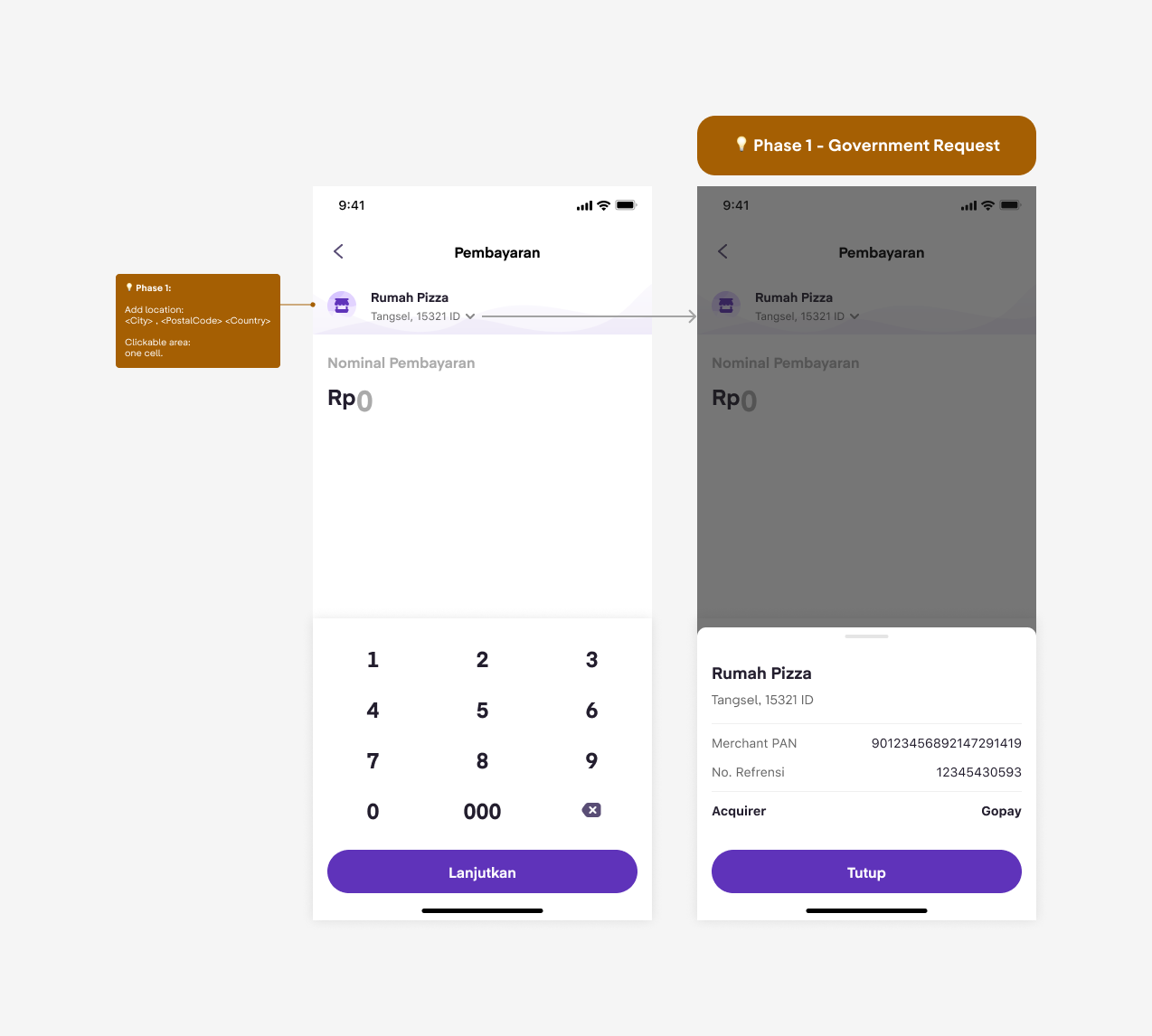
One of government requests
Brand and Design System mismatch
OVO Nabung sat at the intersection of two existing design systems and brands:
Superbank delivered SDK with their own branding and system
OVO required strict adherence to Grab design system and OVO brand
Users needed to understand when they were interacting with OVO, Superbank, or the joint product
At the same time, the project ran under extremely tight timelines, which meant the solution had to be efficient, reusable, and low-friction.
Introducing a new product identity (OVO Nabung) without breaking either system and without over-branding neutral flows became a key challenge.
OVO’s style and colours vs Superbank’s style and colours
Non-Indonesian designers working with Indonesian copy
I needed to define a way of working between our product designers and content designers while being more meticulous with the content in design review sessions.
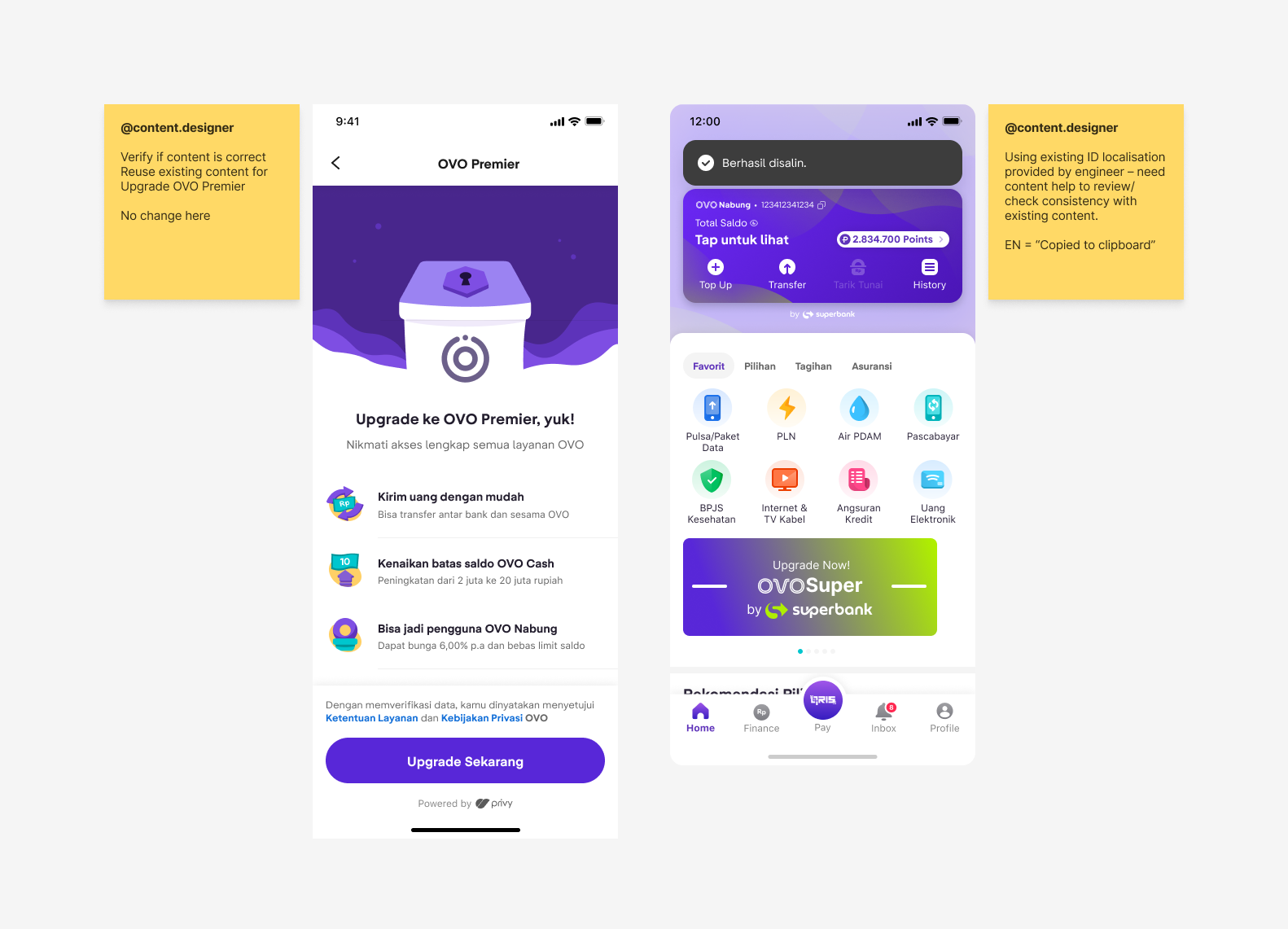
Product designers x content designers
Long-term vs Hard Deadline MVP
We needed something shippable in 3 months (missing the regulator window would force a significant delay) without creating long-term debt especially around transaction history, which would break if not designed correctly upfront.
What I Delivered
Forced early alignment on identity & branding
Leadership was stuck debating names.
I pushed decisions forward by grounding them in:
Clarity on how brand length matters to users, not just for business/marketing for examples “Tokopedia → Tokped”, “Bukalapak → BL”, etc.
Risk of blocking design and engineering timelines
Result:
We established a working name, brand color, and identity rules early enough to avoid delays.
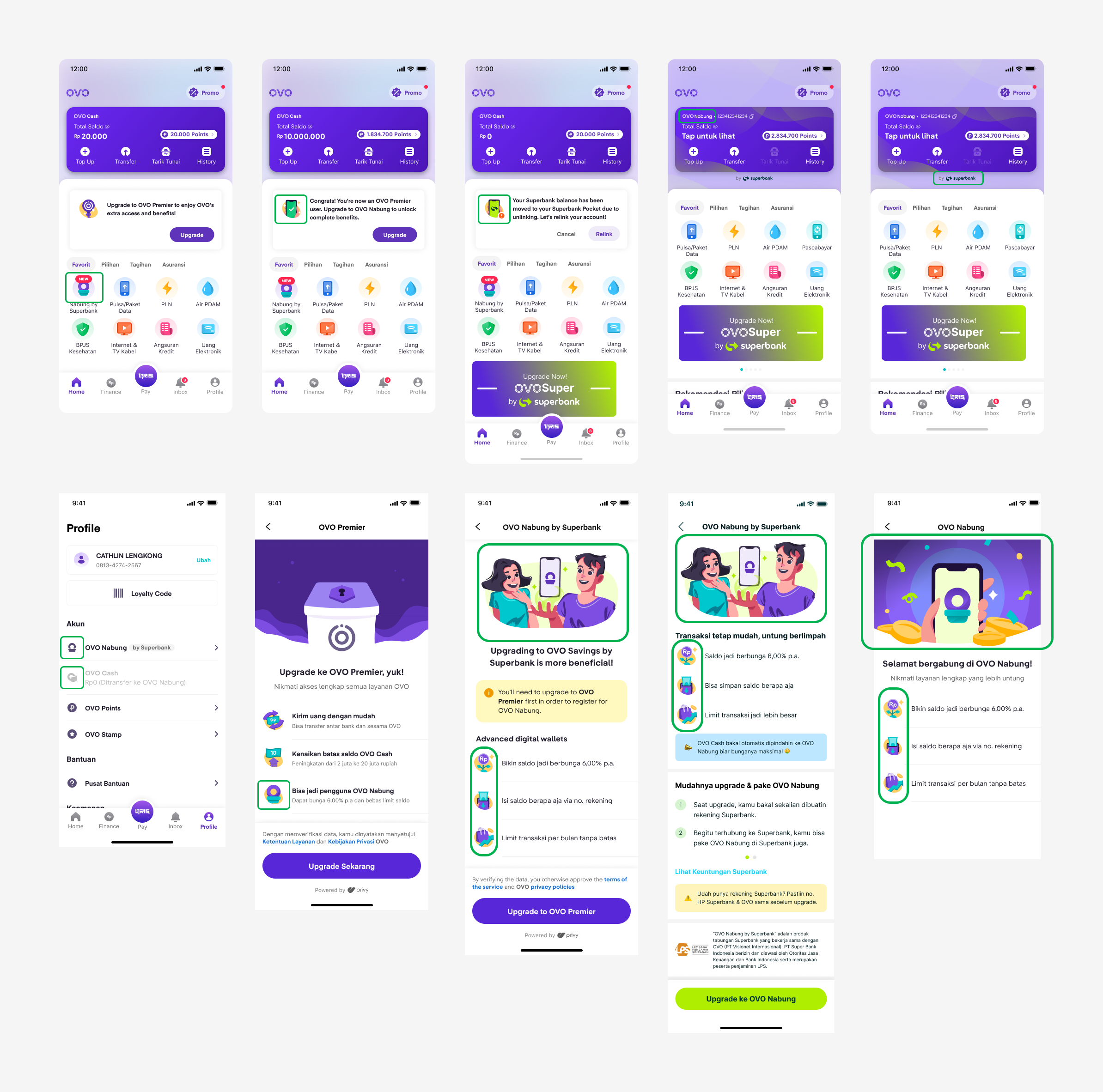
Icons & illustrations based on the respective brandings
Defined the end-to-end upgrade journey
I clarified and aligned the full sequence: OVO Club → OVO Premier → OVO Nabung
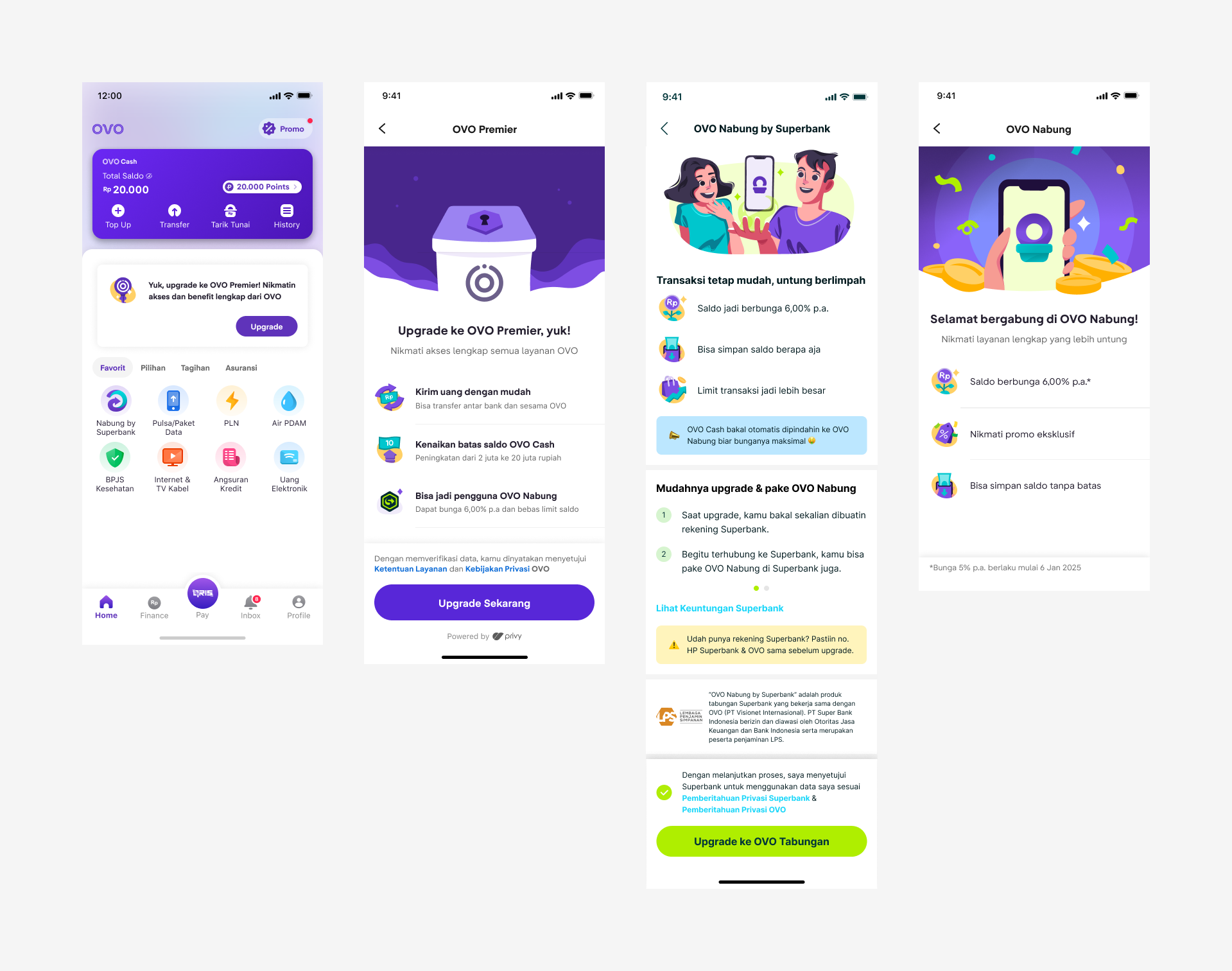
From OVO Club users to OVO Nabung Users
This required:
ensuring flows remained consistent
ensuring language and edge cases were regulator-ready
defining when the user sees OVO vs Superbank branding, or even the combination of both branding (OVO Nabung)
designing the fallback states for blocked/failed as well as taking into consideration the unsupported cases
This became the foundation used by teams across the companies.
Solved the multi-app transaction history problem
To let teams build OVO Nabung transactions into OVO and Grab later, we needed a unified, principle-driven model.
Before this, every team had a different interpretation about which transactions should appear in which app.
If not aligned early, teams would redesign and rebuild multiple times.
I created the transaction history principles that were validated quickly with past research, competitor analysis, and engineering constraint.
If a source-of-funds feels external to users, only show transactions that have been done in the app.
If it feels internal, show all the transactions.
Every transaction must appear on at least one app the user has.
This prevented long-term fragmentation and made v1 shippable.
At the same time, we need to integrate OVO Nabung History into the current history page of OVO with as little effort as possible while aligning with Superbank Team of the possible transaction types for both app.
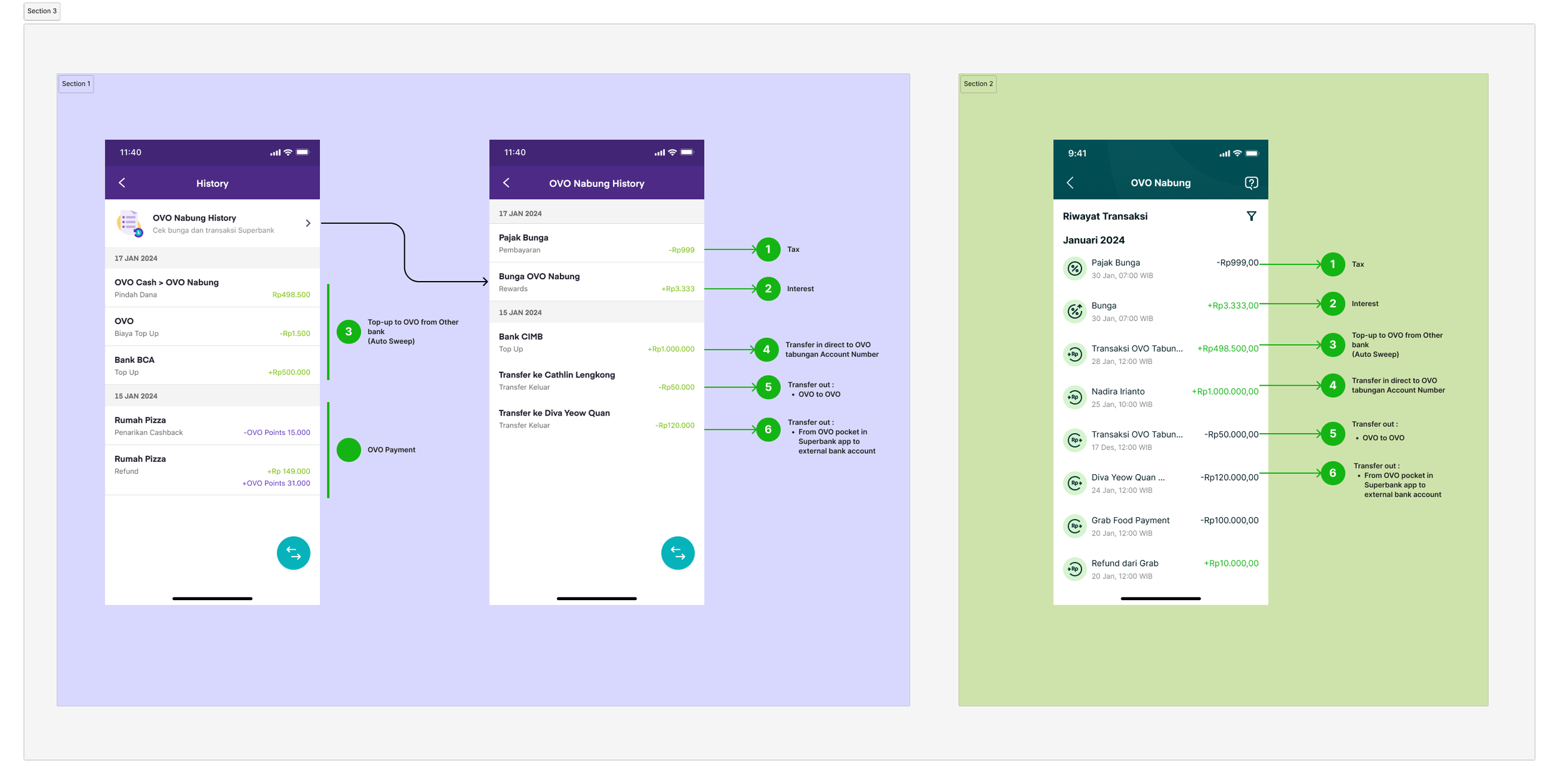
OVO History vs OVO Nabung History
Cross-team alignment across OVO, Grab, and Superbank
I drove the alignment across:
5 design teams
(OVO Payments, Grab Paycore, Grab Onboarding, OVO Funds Movement, Superbank team)Multiple PMs
Content designers from OVO and Superbank
Illustrators from OVO and Superbank
Grab design system team
OVO compliance team
Engineering teams
Because timelines were so tight, my role wasn’t just leading design. It was orchestrating decisions, unblocking teams, and committing to paths quickly to prevent delays.
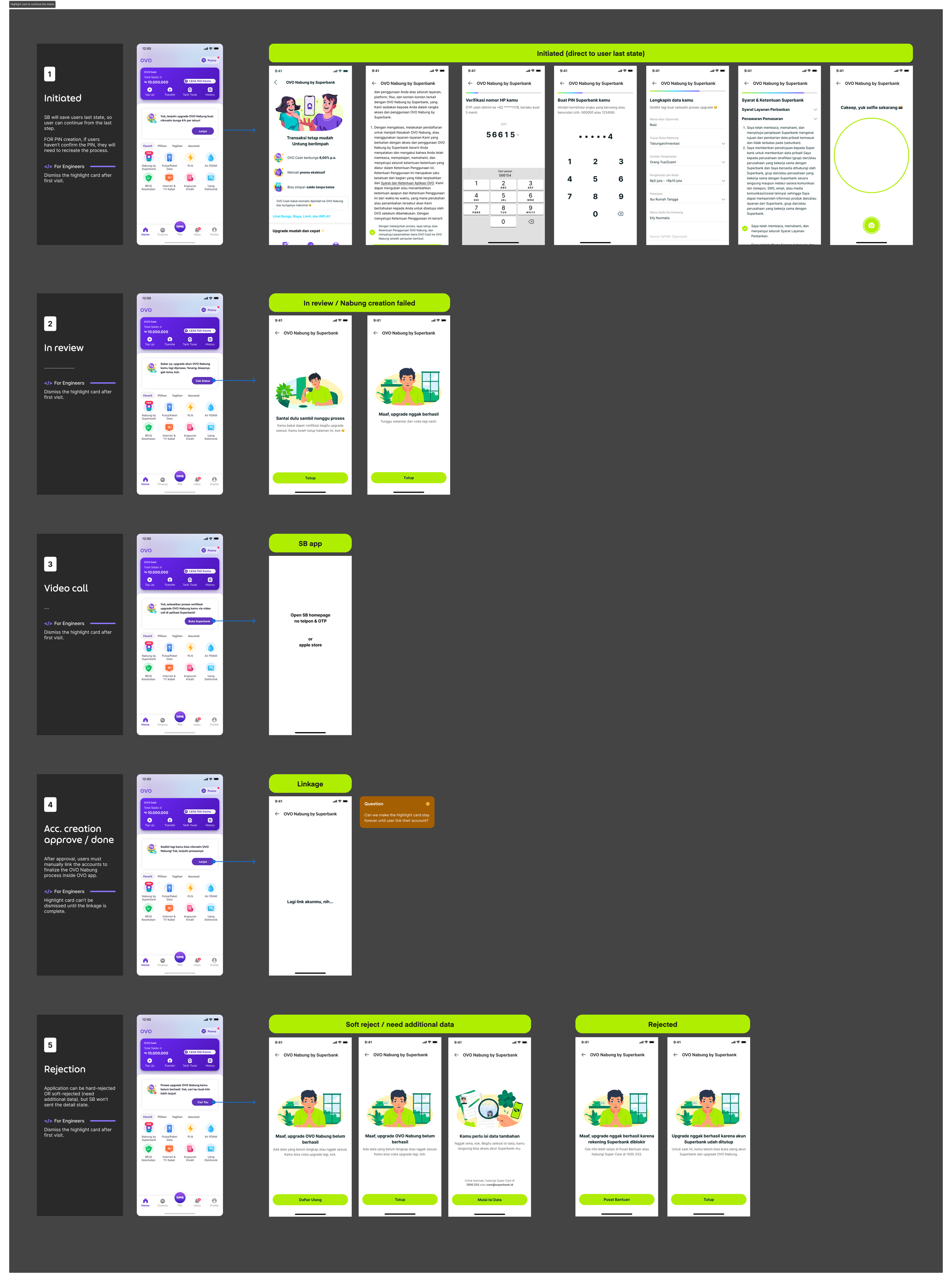
Shipped a regulator-ready MVP on time
The final scope included:
OVO Club → Premier → OVO Nabung upgrade
Existing OVO Nabung account linking and unlinking
Change phone number flow
Block users states
Push Notifications and Emails
Top-up flow
Cash-out flow
Payment and refund flow including promo for OVO Nabung
Unsupported cases since not every feature was available in v1
Help Centre
Brand-consistent UI across OVO + Superbank
Scalable transaction history model
All design was completed ahead of engineering schedule and successfully used in the submission to the regulator.
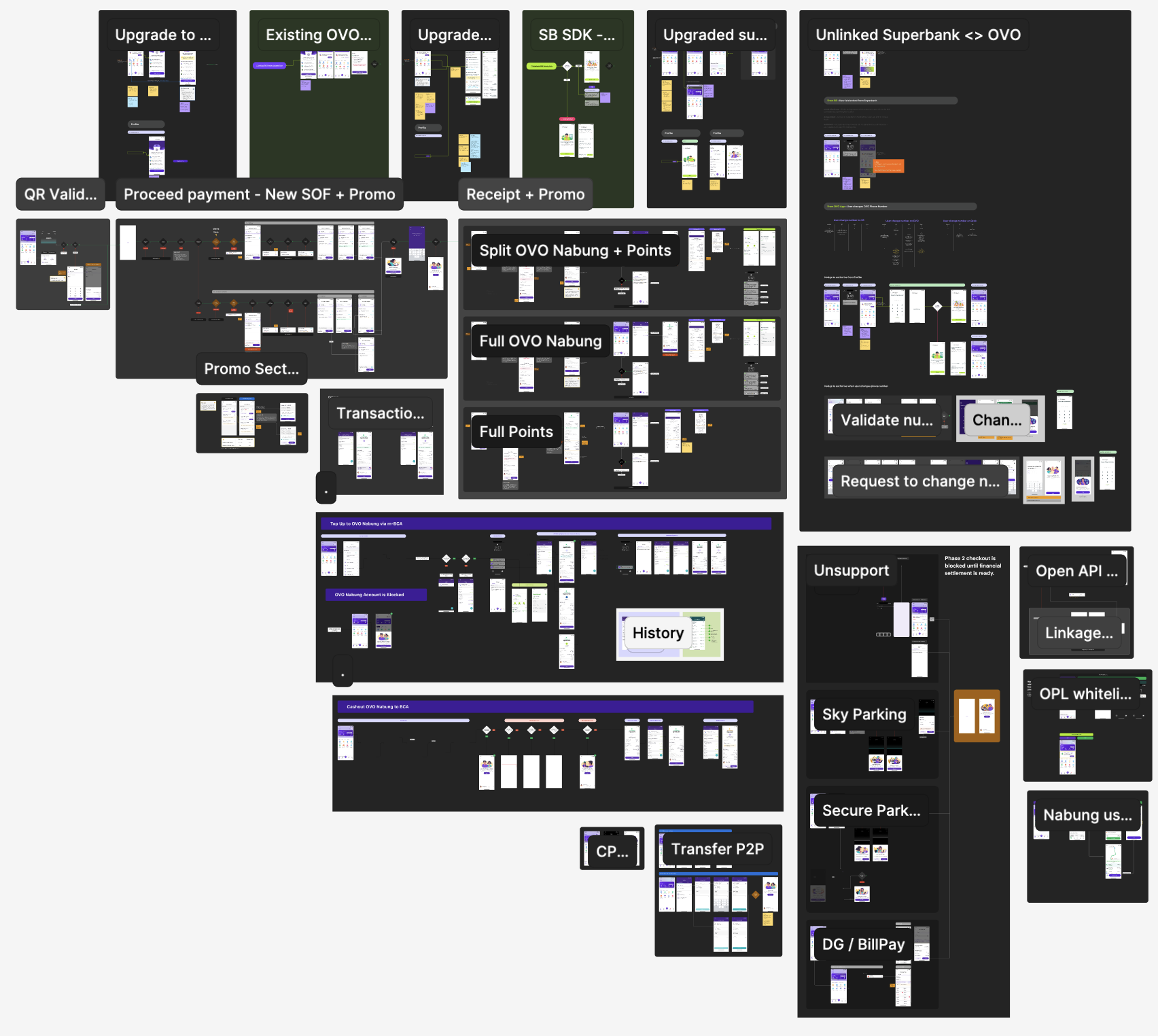
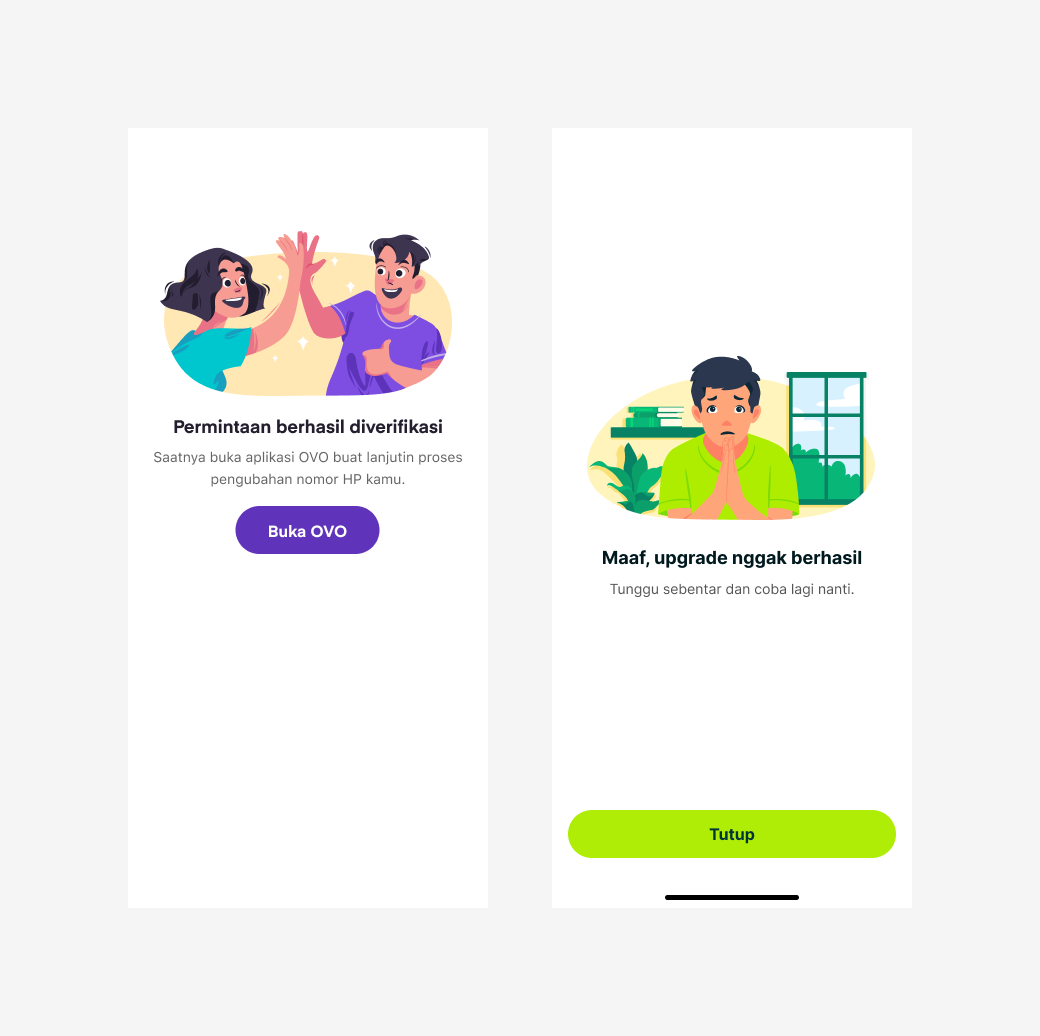
The screens and flows for regulator-ready MVP
Outcome
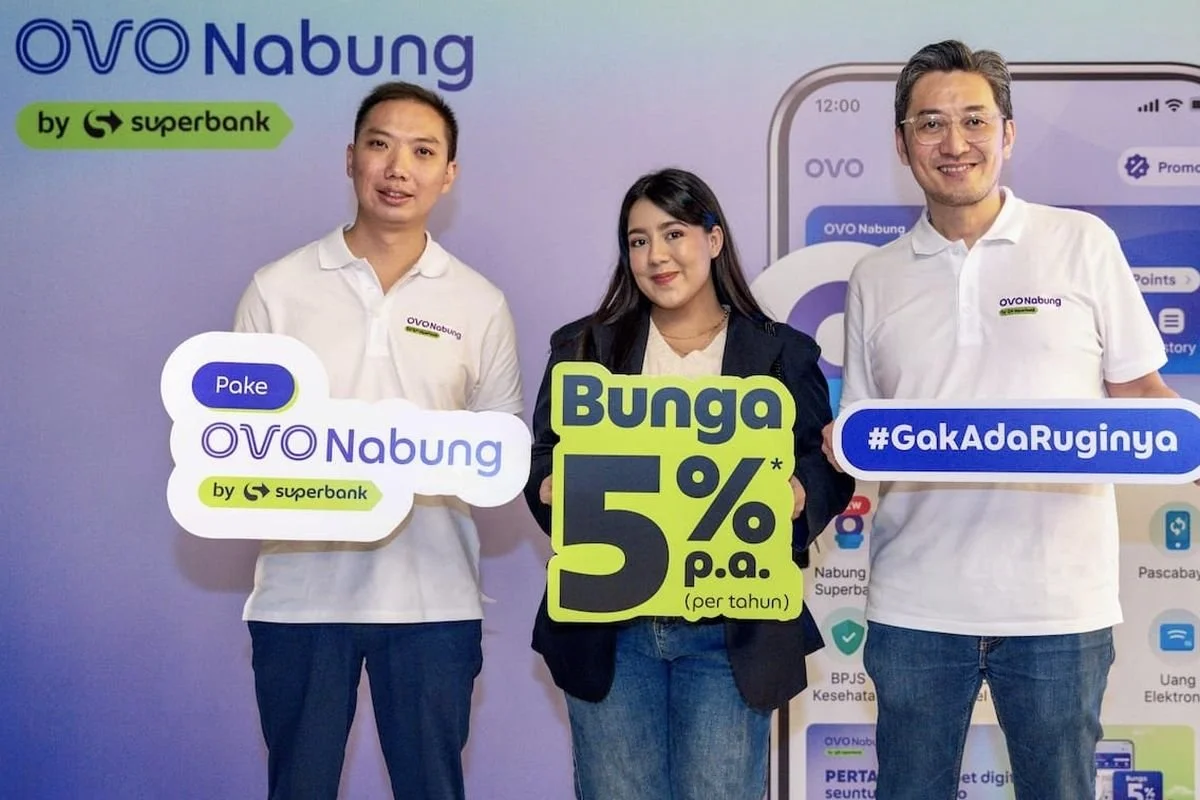
OVO Nabung launch event, enabled by the successful delivery of this work
Regulator-ready launch delivered on time, establishing the foundation for the first 1M users
Delivered all regulator-required design artifacts on time, unblocking submission
Unblocked engineering across two companies through clear system rules and ownership
Aligned three organisations (OVO, Grab, Superbank) on naming, identity, and core flows
Established the transaction history model and core project foundations, creating clarity that allowed teams to scale the product beyond the first phase
Shipped the end-to-end flow with minimal rework, despite high ambiguity and tight timelines
Why it Matters
This project wasn’t about visuals. It was about judgment under pressure.
Operating under extreme time and regulatory constraints
Navigating multi-organisation politics and ownership boundaries
Unblocking teams quickly to prevent delivery stalls
Making high-judgment calls with incomplete information
Balancing MVP delivery with long-term system coherence
Shipping a regulator-ready product in 3 months
UI & Interaction
Growth & Conversion
Product Discovery & Insight
Revamping Sign-Up Process
Redesigned the onboarding flow end-to-end to remove friction and clarify requirements, increasing registration success by 2.8×.
Move Without Authority
Moved complex initiatives forward without formal authority by challenging assumptions, reframing constraints, and restructuring incentives across product and organizational systems.
UI & Interaction
Product Discovery & Insight
Growth & Conversion
Adapting More Variants
Scaled the product detail experience to support more variants using a reusable pattern and component updates that preserved clarity and increased add-to-cart performance.